Minggu, 07 April 2013

New project sales status: Jade Residences


It was reported in our local business tabloid that sales began at Jade Residences condo in Lorong Liew Lian last Friday, with close to 60 units moved by 6pm.

 
Located about 400 metres from Serangoon MRT Station, the five-storey freehold development will have 171 apartments and two shop units. As of Friday, developer Roxy-Pacific Holdings had released 80 apartments and the average price after discounts (inclusive of a 3% early bird discounts) works out to $1,416psf.
 
 
Jade Residences comprises two, three- and four-bedroom units as well as penthouses.

All ground-floor units have high ceilings (up to 4.8 metres) and come with a jacuzzi and a furniture deck, which provides a raised platform that can accommodate a mattress or be used as a study.

Absolute prices of units in the development range from around $845,000 for a 527sqft two-bedroom apartment to $2.65 million for a 1,927sqft duplex four-bedroom penthouse which comes with a roof terrace, attic and private pool.

Prices for the two shop units of 215sqft each has yet to be finalised but they will cost below $1 million each.

So far, the project has reportedly attracted mostly local buyers, predominantly first-timers and second-timers.

The thing that struck the wife and I the most is the duplex four-bedroom penthouse - 2-storey with four bedrooms, a roof terrace and private pool - all housed in a mere 1,927 square footage of space. Back in the good old days (being the old-timer that we are), this will probably be at least 3,000sqft! So it's amazing how much "stuff" developer can squeeze into an apartment unit these days... and how small a living space in each of the areas within a home that buyers are prepared to accept.

Below are more information about Jade Residences:


Kamis, 04 April 2013

Rise of the first-time home buyers!


First-time home buyers have been propping up demand in the local property market.
They are not affected by the latest cooling measures implemented in January since they belong to the group without a mortgage loan.

24-year-old Travis Ye became a condo owner for the first time in September last year, when his parents put down a 30% downpayment for his $1.4 million condominium at eCo.
That's when the sixth cooling measure had been in force for nine months, raising fears of more policy risks.

First-time property buyer Ye said: “Yes, there was a rush. A lot of people now are so afraid that my money today can buy this property. But with all these cooling measures and X amount of money, you cannot really buy a property because of the lower loan tenure, your bigger downpayments, your money shrinks in a way.”

Yet, Mr Ye remains confident that rental income from his three-bedroom unit at eCo in Bedok can generate positive cash flow even after paying off monthly mortgages.

But the fresh graduate will have to top up his loan repayments should interest rates rise above 3.5% per annum.

Some market watchers observed mortgage rates have been rising in the last three months. But some analysts said with Singapore's economy and high employment rate, first timers should be able to meet their home loan obligations.

And, first timers like Mr Ye have kept primary home sales moving.

Developers that launched new projects after the seventh round of cooling measures on 12 January, said at least 1 in 2 buyers don't have an existing loan to service.

Launched on 15 March, 60% of units at D'Nest were bought by those who have not bought a home before.

At Q Bay Residences, that was launched about a week after the latest round of cooling measures, 53 per cent of buyers were first-time property owners.

Developers Channel NewsAsia spoke to said they do not have statistics on first-time owners prior to cooling measures. CapitaLand does not have such statistics.

Analysts also said that the decline in private home sales in February was mainly due to lower demand from investors.

Sale of new private homes in Singapore fell sharply in February - to 708 units, down by nearly 65% from January.

CEO of DistriCT65, Colin Tan said: "I would say that when the developers say that first-time buyers make up more than half of buyers, it is probably not an increase in first-time buyers. It is a decrease in second time buyers or mature buyers - those who have an existing loans. That is why you see the percentage increasing for first-time buyers."

For now, first-timers should prop up the property market.

Deputy MD of Colliers International, Grace Ng said: "For the rest of 2013, demand will be sustainable because first-timers are coming out in force. They are taking opportunity to buy well-located condominiums in view of the various discounts given by the developers."

March has been tipped to be the top month for new home sales in 2013. From the four recent launches, analysts are expecting nearly 2,000 units to be sold last month - surpassing 708 units sold in February.
Source: Channel News Asia

Our take: First-time home buyers will continue to prop up demand.... as long as there's enough of them with rich "backings".


Back in Vegas and into the Vdara!


The wife and I was in Las Vegas for a couple of days last week and we decided to stay at the Vdara. This is a Condo Hotel development in CityCenter - a 67-acre "city within a city" project on The Strip developed by MGM Mirage and completed in 2009.

Back in May of 2010, we had done a review of the various developments that made up CityCenter. The project had just completed and the developer was still selling units then. And ownership at the Vdara included the opportunity to participate in its managed nightly rental program - what this means is that your apartment will be rented out to tourists like us and you get a portion of the rental returns annually.

Units range from 500 to 1,650sqft and the development was previously marketed as primary or vacation residences.

Although the wife and I had been back to Vegas again between 2010 and last week, this is the first time we got up close and personal with Vdara, which started operation in December 2009.

It was definitely an impressive first impression when we arrived at the Vdara. Even before entering the Condo Hotel, we already loved what we see from the exterior.


Once inside, we were greeted by a beautifully furnished lobby. The lighting could have been a tad brighter (which explained the quality of the photo below) but there was really little else to criticize about.
 

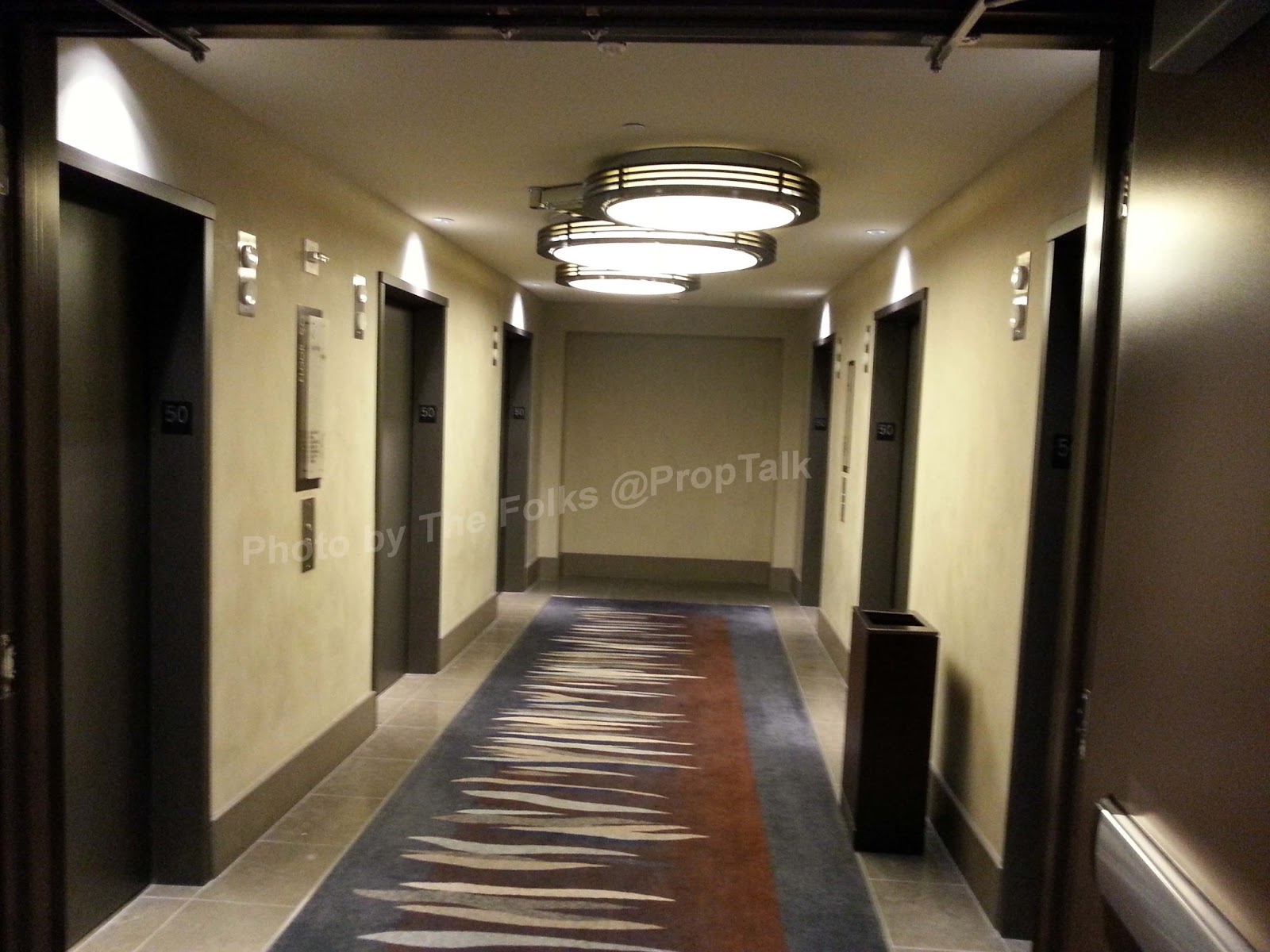
The lift lobby and walkway along the apartments on each floor are designed around an earth tone and elude a sense of class that you will normally associate with 5-star hotels.


The apartment that we stayed in was a deluxe studio unit of about 500sqft. As we open the door of the apartment, we were hit by a sense of deja vu as the unit was an exact replica of the showflat we had seen at the Sales Gallery back in 2010. 
 
As we enter the apartment, we arrived at the kitchenette. This is a fully functional kitchen equipped with cooking hob, microwave, fridge, sink and a dining table for two. The only complaint the wife had about the kitchenette is that the induction hob was not very effective - it took her ages just to boil water to make her instant noodles (we were so sick of American breakfasts while in San Francisco, we actually bought instant noodles from SF Chinatown before heading for Vegas!).


The living room is comfortably sized for up to 4 people and comes with a small study desk. The sofa also double up as a bed if required.


The bedroom is located on the opposite side of the living room and comes with a king-size bed. You also get a great view of the city and bright lights from the set of windows that run across the living and bedroom. And should you require some privacy (as we did when we woke up one morning to find a gondola hanging outside our window), day and night blinds are available and electronically controlled.


The bathroom is huge and equals those of luxury hotels in terms of design and furnishing. It comes with both standing shower and bath-tub, which is something that the wife and I always preferred - we are no fan of bath-tub and hate having to climb into one (thereby risking lives and limbs in case we slip) just to take a shower.


And in case your wondering about the view, below are some photos we took from the inside of our 50th-storey apartment. 
 Views from the apartment

Facilities wise, once can expect Vdara to come with the usual "bells and whistles" associated with a serviced apartment/hotel - café, bar, swimming pool, gym and even a spa! However, it will set up back 60 bucks for a 15-minute shoulder/back massage so definitely not for the faint-hearted (or budget conscious).

Facilities/Amenities

 
  Given the Vdara is part of the MGM group, the Condo Hotel provides direct access (via a sheltered walkway) to the Bellagio next door. So despite the lack of a casino within the development, gambling action is just a mere 10-minutes' walk away.

And for those of you who think that 10 minutes is too exhausting a walk and don't mind braving the outdoor, Vdara is also linked to the Aria Casino & Hotel (another MGM development) located opposite via an external walkway - this will cut your access time to the casino to 5 minutes.


Our parting shot:
  • The wife and I definitely liked the quality of furnishing and fitting at the Vdara, both within and outside of the apartment. We recalled making the same comment after we seeing the showflat back in 2010 and the developer has certainly delivered on this aspect.
  • The one "complaint" we have is that the development (both common areas and within the apartment) can be better lit. This may be deliberate to create the sort of ambience the developer wanted but we do find the lighting especially within the apartment somewhat lacking.
  • There is a lack of storage space within the studio apartment - all you get is a wardrobe that is hardly large enough for more than two weeks' worth of clothing for 1 person. So if one owns the apartment for primary (as opposed to vacation) residence, you either have to be very frugal with your belongings or heavily dependent on external storage.
  • The room rate that we paid for our stay was about $150 per night and we understand this fluctuates between $120 - $200 depending on whether it being the "high" or "low" occupation period. If one had bought the studio apartment for $450K back in 2010 and assuming an average of $150 per night with occupancy rate of about 80% (i.e. 290 out of 365 nights a year), the annual return comes up to be around 9.6%. Not too shabby for an investment but we are unsure how much of a cut on the $150 the developer will levy for their management fee.

Click on the links below to access our previous review of Vdara and other developments within the CityCenter in Las Vegas:
http://www.sgproptalk.blogspot.sg/2010/05/wanna-own-piece-of-las-vegas.html
http://www.sgproptalk.blogspot.sg/2010/05/citycenter-las-vegas-more-pictures.html


Rabu, 03 April 2013

A million thanks!


Three and a quarter years and over 900 blog posts later, SG PropTalk has finally hit the one- million visitors mark. Although the number is small change compared to say, sgCarMart, which reportedly gets over 6.3 million hits a day, the wife and I are rather thrilled by this little milestone that we have archieved.


Without sounding cliched, we are really thankful for the support and participation from our readers since the inception of SG PropTalk. It may take us another 3 years (assuming we make it that far) but the wife and I are eagerly looking forward to the "birth" of  our 2,000,000th visitor!


En bloc wheels continue to slow in 2013?


Some property developers are turning to commercial and mixed development projects to make up for the weak en bloc market.

This comes as transacted deals for the first quarter of 2013 dropped by 20% to $360 million, compared to the same quarter in 2012.

Real estate services firm Jones Lang LaSalle says some 50 en bloc deals amounting to $3.2 billion were transacted in 2011, and 26 deals at $2 billion in 2012.

As of 2013, four deals have been transacted. They comprise of three residential and one commercial property site.

Jones Lang LaSalle's regional director of investments Tan Hong Boon attributes the weaker market to the measures introduced by the government towards residential properties. This includes the Additional Stamp Buyers Duty on residential properties.

Mr Tan said that he expects the amount of en bloc deals for this year to reach between $1.5 and $2.1 billion, with a majority of deals transacted from residential property sites.

Source: Channel News Asia

Senin, 01 April 2013

Private home prices growth slows in 1Q2013!


Prices for private homes grew at a slower pace in the first quarter of the year.
Analysts say the slowdown is no surprise, after the government's latest round of cooling measures in January.

For private homes, prices moderated in the first quarter of this year, rising 0.5% on average, according to flash estimates from the Urban Redevelopment Authority (URA) Price index.
The 0.5% rise is smaller than the 1.8% growth recorded in the fourth quarter of 2012.

Analysts said the January cooling measures curtailed an otherwise rapid rise in property prices.

"The market is still very flush with liquidity in a very low interest rate environment. The measures had an impact in the first two months of its introduction, that is, in the month of January and in particular in the month February when developers did not launch any new projects. If you look at the February numbers, just over 700 units of primary new home sales were done," said Donald Han, special adviser at HSR International Realtors.

Market watchers said prices of high-end properties in the city are expected to stay somewhat flat - up to 1% growth - for the rest of the year.

But private homes in the suburbs will climb as much as 4 to 5% by the end of the year, as demand is stable and developers continue to dish out projects.
Source: Channel News Asia


Selasa, 26 Maret 2013

Property cooling measures ineffective?


Not exactly... said Philip Loh in his letter published in the Forum page of our de facto English newspaper today.

Below is the full transcript:

=================================================================
THE Singapore Real Estate Exchange (SRX) reported that resale suburban condominium prices rose by 5.1% last month ("Resale suburban condo prices rise"; March 9).

This gave the impression that suburban property prices had gone up by 5.1% when, in actual fact, prices may have softened a bit from January.

The SRX reports average per square foot (psf) figures, which depend a lot on the mix of properties transacted.

As the sales volume plunged for the general resale market (older private properties), the sub-sales of private properties that were still under construction, about to get their temporary occupation permit (TOP), or just received their TOP (new properties) will pull the average psf price up.

Also, the sizes of these sub-sales units are usually smaller, which will generally fetch higher psf prices.

The mix of private properties transacted is simply getting newer and smaller. Even if real actual prices were to remain the same, the SRX would still have reported higher average psf prices as long as the mix of transacted units was skewed towards the "newer" and "smaller" trend.

The more balanced Urban Redevelopment Authority (URA) private property index reported a price gain of 2.8% last year, down from the 5.9% gain the year before ("Prices of suburban condo units climb 3.4% on strong demand"; Jan 3).

The difference is that the URA index adjusts for the size and age of private properties transacted, whereas the SRX does not.

As the Housing Board does not build shoebox flats, and new flats can be sold on the resale market only after the five-year minimum occupation period, the SRX actually reported a drop in last month's HDB resale prices.

Sales volume was reported to have dropped sharply last month and developers' share prices plummeted as a result of the poor outlook.

All these, I believe, are more indicative of the true state of the Singapore property market now.
The SRX's reported average psf price is a misleading indicator of the health and price trend of the Singapore property market. As a result, many Singaporeans may feel that the Government's property cooling measures are ineffective when, in actual fact, they could be working very well.
===================================================================

The wife and I appreciate the insight given by Mr Loh on the difference between the SRX and URA indices. And on the subject of price, we feel that as long as liquidity amongst potential home buyers remains high, private home prices will continue to rise, albeit at a slower pace given the latest set of cooling measures.